The Irrigation Steel Bridge in Saraphi: Where Real Life Happens and Real Photographs Are Made
- Tatiana Mocchetti
- Mar 28
- 12 min read

On finding your place, building connections, and why handing someone a photograph changes everything
Every Photographer Needs a Place Like This
There are locations you visit once for the light and never return to. And then there are places that become part of your practice, part of your rhythm, part of the reason you pick up the camera in the first place.
The Irrigation Steel Bridge in Saraphi, a short drive south of Chiang Mai, is that second kind of place for me.
I discovered it the way you discover the best places: not by searching, but by wandering. I had followed the road along the canal on a late afternoon, the light dropping toward that particular gold that only lasts twenty minutes and makes everything look like it was painted. The bridge appeared around a bend — old rust-orange steel framing against a wide sky, its triangular lattice structure reflected in the still water upstream. And below it, the water running fast and white over the irrigation weir in long diagonal lines. And there were families. Everywhere. Children already in the current, mothers unpacking food on the bank, fathers watching from the edge, two people just sitting at the concrete lip of the weir with the water rushing past them as if it had always been exactly that simple.
I stopped the bike. I sat for a moment and just watched. Then I picked up the camera.
That was the beginning of something I keep coming back to, at least once a week. It is close to home, which helps, but honestly even if it were further I would find a reason to come back.

The Place Itself: What You See When You Arrive
Before anything else, let me describe what this place actually is, because the photographs only make sense in context.
The Irrigation Steel Bridge spans a wide irrigation channel in Saraphi district, about 15 kilometres south of Chiang Mai city centre. What makes it remarkable as a photography location is not the bridge itself, though the rust-orange steel lattice is genuinely beautiful, especially in the late afternoon light when it glows against the green of the trees behind it. What makes it remarkable is the weir below.
The weir is a long, angled concrete structure over which the water runs in wide, fast sheets, catching the light in constantly shifting patterns. It is shallow enough to stand in, fast enough to feel, and at certain times of day spectacular enough to make everyone who approaches it want to get into it immediately. Which they do.
The geometry of the place is extraordinary for a photographer. From the bridge above you have an elevated position looking down over the weir, the water, and whoever is in it. You can shoot wide to get the whole scene, or you can work with the 85mm and pull individual moments out of the flow. The diagonal lines of the cascading water create natural compositions. The silhouettes of figures against the silver shimmer of moving water are almost unavoidable.
And then there are the fishermen. The same weir that draws families for picnics and children for play is also a working fishing spot. Men with cast nets, some young with tattoos and baseball caps, some older in conical hats and rubber boots, wade into the current and throw their nets in wide, spinning circles. They have been doing this for years alongside the picnickers and the children, and the coexistence of these two entirely different relationships with the same water is one of the things that makes this place endlessly interesting to photograph.



Why the End of the Afternoon Is the Only Time to Be There
Timing is everything in street photography, and at the Irrigation Steel Bridge, the end of the afternoon is not just the best time to shoot. It is the only time that makes sense.
Earlier in the day the bridge is quieter. The light is flatter. The families have not yet arrived. The fishermen may be there, and they are always worth photographing, but the full richness of the scene belongs to the late afternoon.
Then, somewhere around four o'clock, things begin. The heat of the day has softened. School is finished. The working week is winding down toward evening. And Thai families, who have an instinct for finding joy in the simplest outdoor spaces, begin to appear.
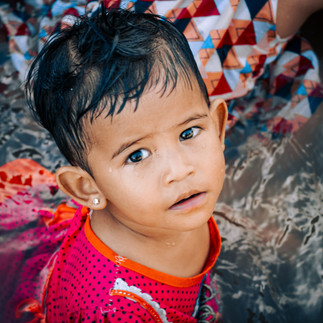
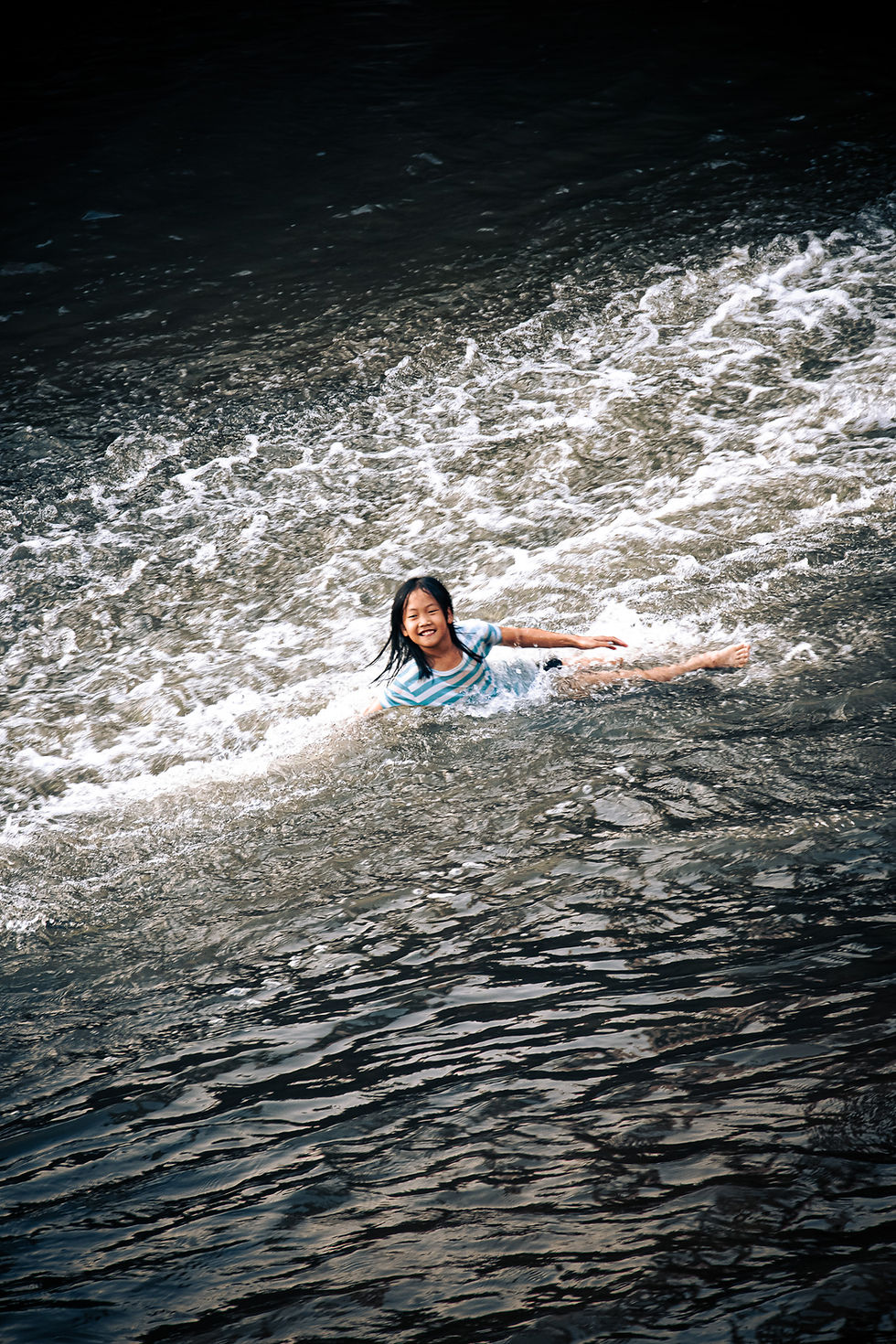
By five o'clock the water is full of children. Not organised, not planned, not performing for anyone. Just children doing what children have done beside moving water for as long as there have been children and moving water: splashing, chasing, throwing themselves into the current and letting it carry them, screaming with a particular kind of delight that seems to exist only when cold water hits warm skin in warm air. Two girls sitting cross-legged in the shallows, one aiming a stream of water directly at the other who is already laughing before it arrives. A boy in a Paw Patrol rashguard running hard through the current, the spray erupting around his feet in an explosion of white. A girl in a striped t-shirt lying flat in the flow, arms wide, letting the water carry her weight, smiling at the sky.
The light at this hour comes in low and sideways, catching the water in motion, turning the spray into something luminous. The steel of the bridge goes warm and dark. And upstream of the weir, the still water holds a perfect reflection of everything above it.
This is the light I wait for. This is the light that does half the work.
What Real Life Looks Like Through a Lens
I want to say something about what I mean when I talk about real life photography, because I think it is sometimes misunderstood as simply pointing the camera at whatever is in front of you and pressing the shutter.
It is not that.
Real life photography is the discipline of being present enough, patient enough, and unobtrusive enough that the life in front of you continues as if you were not there. It requires a particular quality of stillness, not physical stillness necessarily, but an internal stillness, a quality of not-wanting that allows you to observe without disturbing.
At the Irrigation Bridge, this means arriving without urgency. Sitting on the bank for a while. Letting the children register that I am there and then lose interest in me. Letting the parents see that I am not pointing the camera yet, that I am simply present, watching the same scene they are watching with something close to the same pleasure.
By the time I raise the 90D, most people have forgotten I am holding it. The children are too busy being children. The parents are too busy watching their children. The fishermen are too absorbed in reading the water. And in that collective forgetting, the photographs become possible.
There is a frame I keep coming back to from this location: a father and his young son, both in matching red, sitting side by side on the sandy bank with their backs to me, watching the river in the fading light. They are not talking, or if they are it is the kind of talking that barely breaks the silence. I did not approach them. I found the angle and waited. That photograph exists because I was quiet enough, long enough, that they forgot I was there.
These are not the photographs you plan. They are the photographs that happen when you have done everything right except press the shutter.

The Conversation Comes Before the Camera
Something I have learned at this bridge, reinforced every time I go back, is that the best photographs almost always follow a conversation.
Not necessarily a long conversation. Not always a conversation in a shared language. But some form of human exchange that establishes, before anything else, that I am a person with good intentions rather than an apparatus pointed at people who did not ask to be photographed.
Sometimes this is as simple as sitting near a family and smiling at the right moment. A child runs up to look at the camera and I show them the screen and they dissolve into giggles and run back to tell their mother, and now their mother is looking at me with amusement rather than wariness, and we are already in a conversation without having said a word.
With the fishermen it is different. They tend to be more self-contained, more focused on the work. The young man throwing his cast net, the older man wading the weir with his net rolled under his arm, the figure silhouetted against the backlit water in a conical hat with his net rising above him in the air: these are people who are not there for social interaction. They are there to fish. The approach that works is the same one that works everywhere: patience, presence, and the willingness to simply be nearby long enough that you stop being an event.

Lightroom Mobile and the Gift of the Immediate Image
Here is something that has changed how I work at this location entirely.
My Canon 90D connects via Bluetooth to my phone. After I shoot, I can transfer images directly to Lightroom Mobile, make a few quick adjustments, and have an edited photograph ready to share within minutes. Exposure, contrast, a little clarity on the faces, sometimes a crop. Nothing that takes more than two or three minutes per image.
Then I share it. Via Line, which is how most Thai families communicate, or via AirDrop if they have an iPhone. And I watch what happens.
It is always the same. The mother looks at the image of her child in the water and something moves across her face. Not surprise exactly, though there is some of that. Something more like recognition. This is my child at the exact moment when she was most herself, and it fits in my hand and I can keep it.
I have had fathers hold the phone up to show grandparents standing nearby, three generations gathered around a small screen looking at a photograph made twenty minutes ago. I have had the girls in the water ask to see themselves, and held the phone down so they can look with the particular fascination children have for their own image, as if meeting themselves for the first time. I have had a fisherman take the phone carefully in wet hands and hold it close to study a photograph of himself throwing his net, then look up with an expression I could not name but would recognise anywhere.
This exchange, the image given back to the people in it, is not separate from the photography. It is the point of it. It transforms what could be extraction into something reciprocal. I was here. I saw something worth seeing. Here it is. It is yours.

The Fisherman Who Asked Me to Follow Him
Not everyone who comes to the Irrigation Steel Bridge in Saraphi comes for the picnic.
One afternoon I noticed an old man sitting apart from the families, completely still, a fishing line in the current below. Not a net fisherman, just a line, just patience. When I approached and sat nearby, he looked at me, looked at the camera, and with a gesture that needed no translation, beckoned me to follow him along the bank to a quieter spot. He settled into position and glanced back once as if to say: now you can photograph.

I came back a few days later. He was there again, this time animated and proud, lifting a net bag to show me his catch. His smile was the face of someone who has been proven right about something that matters. I photographed him holding it up, the straw hat, the purple scarf, the wooden structure behind him, the satisfaction entirely unperformed.
Then I came back a third time. Not with a camera. With a printed photograph of him from that first afternoon.
He held it without saying anything. Then looked up and nodded once, with a seriousness that felt like the most complete thank you I have ever received.
That is what photography at its best actually is. Not the gear, not the light, not even the image itself. The moment when a photograph becomes something someone holds in their hands and recognises as their own life, made visible.

What the Bridge Has Taught Me About Photography
I have made hundreds of photographs at the Irrigation Steel Bridge in Saraphi. Some of them are among the best work I have done. Not the most technically complex, not the most dramatically lit.
But honest. Completely honest images of people being themselves in a place they love, at the time of day when the light is generous and the water is cool and there is nowhere else anyone needs to be.
A boy suspended mid-run, water exploding around him. Two women in the current, one already sitting, one mid-splash, both gone completely into the moment, the golden light turning everything around them molten. Two silhouettes on the weir against the silver shimmer of moving water, small against the geometry of the place. A fisherman in a conical hat, backlit into near-silhouette, his net rising above him against the light like something ceremonial.
These photographs exist because I showed up. Consistently, without a plan, without urgency. Because I sat on the bank long enough to stop being an event. Because I talked to people before I photographed them and gave photographs back after. Because I understood that this place has its own rhythm and my job was to find it, not to impose one.
If you are in Chiang Mai and you want to understand what street photography as a practice of connection actually looks like, go to Saraphi on a weekday afternoon. Take your longest lens and your most unhurried self. Sit on the bank and wait for the families and the fishermen and the light to arrive.
Then wait a little longer.
The photographs will find you.

Practical Notes for Photographers
Getting there: Saraphi district, approximately 15 kilometres south of Chiang Mai city centre. By motorbike or car via Route 108 south, following signs toward the canal.
Best time: Arrive by 4pm. Families and children peak between 4:30 and 6:30pm. Fishermen can be found throughout the day. Stay for the last light, the weir at sunset is extraordinary.
Shooting from the bridge: The elevated position gives you a wide view over the weir for environmental frames. Work the 85mm from here for compressed, graphic shots of figures against the water.
Shooting at water level: Get down to the bank on the downstream side for portraits and interaction. This is where the conversations happen.
Gear: Canon EOS 90D with Canon EF 85mm f/1.8. Minimum 1/800s to freeze the spray, 1/1000s for fast-moving subjects. Shoot wide open at f/2.0 for late afternoon portraits with the water as background.
Sharing on the spot: Canon Bluetooth to Canon Camera Connect app, edit in Lightroom Mobile, share via Line or AirDrop. It takes five minutes and it changes everything about how people receive you.
All images in this article were made at the Irrigation Steel Bridge, Saraphi, Chiang Mai, with the Canon EOS 90D and Canon EF 85mm f/1.8, in the hour before sunset.
Tags: Irrigation Steel Bridge Saraphi, Chiang Mai photography locations, street photography Thailand, Canon 90D Lightroom Mobile, real life photography, family photography Thailand, Saraphi Chiang Mai, where to photograph in Chiang Mai, candid photography Thailand, Canon EF 85mm f1.8, fishing photography Thailand, photography connection, Lightroom Mobile editing, Canon Bluetooth transfer, hidden photography spots Chiang Mai


Comments